catholicPittsburgh.org is the place for information, news, commentary, reflections and community building among the people of God who are renewing the Catholic Church in Western Pennsylvania.
More about us
Welcome ...
Partnering Groups
The following organizations are partners with catholicPittsburgh.org:
Working For a Future We Can Belive In
Because justice, compassion, equality, peace and truth are the core of the Gospel message in every place and time, everyone is invited to reflect on working for a future we can believe in. This will be a chance for those who believe in Gospel values to come together in solidarity and mutual support for one another, to share feelings, have group discussions and pray together.
Sunday, February 19, 2017, from 1:30 to 3:30 pm at Sullivan Hall (behind the former St. Mary of the Mount School), 131 Bigham Street, Pittsburgh PA 15211.
Here is a flyer for the event.
Association of Pittsburgh Priests' Fall 2016 Speaker Series
September 22: Tony Norman
Faith, Fear and Politics: How to Keep a Clear Conscience on Election Day
The award-winning columnist at the Pittsburgh Post-Gazette and journalism professor at Chatham University, arrives just in time to share his incisive, informed views on how to approach this year’s presidential election.
October 27: Jame Schaefer, Ph.D., Associate Professor at Marquette University
Ecological Conversion, Developing Virtuous Communities
Her work – and books – focus on the ways in which theology, natural sciences, technology and ecological ethics relate to and impinge upon each other.
November 7: Robert Mickens, Editor–in-Chief of Global Pulse
The Impact of Pope Francis on the Church in Rome, the Bishops Around the World,and the People in the Pews
Global Pulse presents news, features, and analysis from a Catholic perspective. Robert Mikens is also a frequent contributor to the National Catholic Reporter.
December 5: Tina Whitehead
Seeing the Other
Tina has been volunteering in Jerusalem with Sabeel, a Palestinian Christian Peace and Justice movement. During summers, she teaches and advocates for the Palestinian people in classes on The Palestinian Perspective.
All presentations will be the Kearns Spirituality Center, 9000 Babcock Boulevard, Allison Park, PA 15101 at 7:00 pm.
Suggested donation is $20.00 per presentation or $65.00 for all four.
For questions, Fr, John Oesterle: 412.232.7512 or johnoesterle2@gmail.com.
Video of Ilia Delio, OSF Presentation on March 6, 2016
Association of Pittsburgh Priests presented a lecture by Ilia Delio, OSF: “Co-Creating an Unfinished Universe: Challenges and New Directions” on March 6, 2016. You can watch her presentation here in two parts:
Ilia Delio, OSF, Ph.D. is a Franciscan Sister of Washington, DC and American theologian specializing in the area of science and religion, with interests in evolution, physics and neuroscience and the import of these for theology.
She holds doctorates in pharmacology from the New Jersey Medical School/School of Biomedical Sciences, and in historical theology from Fordham University. She is a recipient of a prestigious Templeton Course in Science and Religion award. Her 17 books include Christ in Evolution; Care for Creation; The Emergent Christ; The Unbearable Wholeness of Being; and Making All Things New.
Sr. Ilia is currently the Josephine C. Connelly Endowed Chair in Theology at Villanova University.
Rev Warren W. Metzler (1937-2016)
Reverend Warren Metzler passed to his eternal reward on Friday, January 1, 2016, after a brief illness.
Warren Metzler was born in Braddock Hospital July 20, 1937, the second of 4 children to Paul W. and Ellen (Zentner) Metzler. He attended elementary school in Whitaker and graduated from St. Thomas High School in 1955. He attended Minor Seminary at St. Gregory in Cincinnati and Major Seminary at St. Vincent in Latrobe, graduating in 1964. He was ordained for the Diocese of Pittsburgh on May 9, 1964 by Bishop John Wright and offered his First Mass the following day at St. Rita Church in Whitaker.
Father’s assignments as a parochial vicar were somewhat evenly divided over 17 years between Most Blessed Sacrament in Natrona Heights, St. Susanna, Penn Hills and St. Edward, Blawnox. During that time he served for 15 years as a Master Catechist for the diocesan CCD, regional and twice national chaplain to the Christian Family Movement, and hospital chaplain to several area hospitals. From 1972 to 1976 Father was chairman of the Association of Pittsburgh Priests, and he has served as President of the Wilkinsburg Ministerial Association. After his 25th ordination anniversary, Father returned to school to Duquesne University where he received his second Master’s degree in Theology, this time in Health Care Ministry.
He was Pastor of St. James Church in Wilkinsburg for 34 years, longer than any other in the church’s history.
Association Of Pittsburgh Priest Speaker Series 2015
The 2015 Speakers Series of the Association of Pittsburgh Priests will conclude on Thursday, November 12. The final talk will be given by St. Joseph Sister Kathy Sherman from La Grange, Illinois. She is a musician-composer, a gifted singer, liturgist and a Director of Spiritual Formation. Her talk is entitled: "Love Cannot be Silenced: Our Message and Our Mission" and will be offered on November 12. The world/planet is crying out for healing, hope and communion. The evening will invite reflection on the gift and challenge of incarnating the Love of God at this moment in history. As disciples, in community, we give witness to the Gospel by proclaiming to the world that "love cannot be silenced." Reflection will include Scripture, story, and original music by Sherman, who began writing music and lyrics in 1966 and has published at least fourteen CD's. As an example, her song, Language of the Heart, addresses the images of families affected by the Vietnam War and reaches across boundaries to reconcile and interconnect divisions.
The talk will be held at Kearns Spirituality Center, 9000 Babcock Blvd. in Allison Park behind the Motherhouse of the Sisters of Divine Providence from 7 - 9 PM. To RSVP, call 412-366-1124 or contact kearns@cdpsisters.org. The fee is $20. For further information about the upcoming talk or to find out how to become a member of the Association of Pittsburgh Priests, contact Fr. John Oesterle @ 412-232-7512.
Mark your calendars now for March 6, 2016 for the first talk sponsored by the Association of Pittsburgh Priests in 2016. Sr. Ilia Delio, OSF will speak on “Co-Creating an Unfinished Universe: Challenges and New Directions”.
Roy Bourgeois Wins Standing Ovation at APP Talk By James McCarville
Roy Bourgeois won a standing ovation at the close of the second event in the Association of Priests’ Speaker Series September 1, with over 150 persons in attendance. His theme, “My Journey from Silence to Solidarity: The Struggle for Justice and Equality”, also sparked a lively discussion. The series is held at the Kearns Spirituality Center in Allison Park.
Roy spoke of his personal growth from a Naval Officer in Vietnam, and a witness to the suffering there, to a Maryknoll priest in El Salvador and Bolivia where he said the suffering was worse. What hurt him most, he said, was that he found out that the people inflicting the suffering were being trained by the US at School of the Americas (SOA) in fort Benning, Georgia.
His activism first got him in deep trouble in Bolivia, from which he was deported. He then returned to the US. After learning that the soldiers who had assassinated the six Jesuits in El Salvador had been trained at SOA, he established SOA Watch. Each year now, on the weekend before Thanksgiving, thousands of people arrive at Fort Benning to protest the use of American funds for this purpose. Last year the number grew to over 15,000.
For his activism he was nominated for the Nobel Peace Prize. For the same reason, he also spent four years in federal prison. He called that the best long retreat he had ever been on.
While back in America, he said, he became aware of a different kind of suffering, that of the women who were denied equality in the priesthood. He called it a “grave injustice…deep sexism” in the Catholic Church. While his order had warned him about his inconsistency with Catholic teaching on this subject, he continued to speak out. Shortly after a live 15-minute interview on Vatican Radio, he was notified that he had been “separated” from the Maryknoll order. The interview was supposed to be about the SOA, but, he said, and it was for the first 13 minutes. For the last minute, however, he could not remain silent on gender issue either. Just like the path he followed in Latin America and at Fort Benning, It was a question of conscience and of solidarity.
In 2012 the Vatican “dispensed” him from his sacred vows. When asked if anything good came out of that, with a smile he says, he “spends a lot less time in meetings now’. Nonetheless he remains upbeat on the reforms he hopes to see in the Catholic Church.
Solidarity was the theme throughout the presentation, and the importance of not remaining silent. For his outspokenness, in 2011 he received the “21st Century Prophet Award” from Call to Action – PA.
The next speaker in the series will be Dr. Daniel Scheid, a theology professor from Duquesne University speaking on Pope Francis’ encyclical, “Laudato Si, Be Praised: On the Care for Our Common Home”. It will take place on October 7, 2015, at 7:00 pm, also at the Kearns Center, 9000 Babcock Blvd, Pittsburgh, PA, 15101.
The Association of Pittsburgh Priests (APP) is a diocesan-wide organization of ordained priests and non-ordained women and men who act on our baptismal call to be priests and prophets to carry out a ministry of justice and renewal, rooted in the Gospel and Spirit of Vatican II. For more information on APP contact John Oesterle at johnoesterle2@gmail.com.
For information on the Speaker Series, contact Sr. Mary Joan Coultas at kearns@cdpsisters.org.
For more information on the School of the Americas Watch, see www.soaw.org.
Jim McCarville is a freelance writer who lives in the North Hills, he can be contacted at jim.mccarville@gmail.com.
Association Of Pittsburgh Priest Speaker Series 2015
It is with great anticipation that we announce this year’s speaker’s series planned by the Association of Pittsburgh Priests (APP). Because of the positive response from previous years, we have decided to increase the series from three speakers to four this year. We invite you to put them on your calendar and attend all four if you can and invite others who are interested to join you.
Our first talk will be held on Wednesday, August 12 with Joshua McElwee, Vatican Correspondent for the National Catholic Reporter. He is a graduate of Catholic University and the winner of numerous awards. His title is, “What Can We Expect of the Synod on the Family?” The challenges to family life around the world led Pope Francis to call a Synod, a special worldwide meeting of Catholic Bishops. The focus of the current Synod begun last fall and continuing this fall accentuates the complexities of promoting and supporting family life in the 21st Century. Two questions that McElwee will address in August are: “Will the bishops find common ground on these important issues and can Church tradition evolve as a living tradition?”
The second talk in the series will be given by Roy Bourgeois. His talk is entitled: “My Journey from Silence to Solidarity: The Struggle for Justice and Equality”. It will be presented on Tuesday, September 1. Bourgeois will share his personal faith journey from Vietnam to Maryknoll and priesthood, to ministry with the poor in Bolivia. Returning to the U.S. Roy became an outspoken critic of U.S. foreign policy in Latin America. In 1990 he founded the School of the America’s Watch for which he has been nominated for the Nobel Peace Prize. In 2012 he spoke publicly in favor of ordination of women to the Catholic priesthood, which led to his expulsion from Maryknoll and the priesthood. Bourgeois has spoken in Pittsburgh several times with the most recent visit sponsored by the PA Call to Action Chapter that recognized him for his continuous prophetic witness to Gospel values.
On Wednesday, October 7, Dr. Daniel Scheid, from the Theology Department at Duquesne University, will speak on: “Laudato Sii (Be Praised): On the Care of Our Common Home”, Pope Francis’ encyclical on the environment. Scheid will explore various themes of Pope Francis’ groundbreaking encyclical. Drawing on his namesake, St. Francis, Pope Francis underscores that care for the Earth, “our common home”, is not marginal to the Christian vocation, but central. In Providence, God’s plan indicates an “integral ecology” that calls all to be protectors of creation and of each person. Scheid will also highlight the main themes and propose directions for future development of Catholic ecological teaching.
The final talk will be given by St. Joseph Sister Kathy Sherman from La Grange, Illinois. She is a musician-composer, a gifted singer, liturgist and a Director of Spiritual Formation. Her talk is entitled: “Love Cannot be Silenced: Our Message and Our Mission” and will be offered on November 12. Our world/planet is crying out for healing, hope and communion. The evening will invite reflection on the gift and challenge of incarnating the Love of God at this moment in history. As disciples, in community, we give witness to the Gospel by proclaiming to the world that “love cannot be silenced.” Reflection will include Scripture, story, and original music by Sherman, who began writing music and lyrics in 1966 and has published at least fourteen CD’s. As an example, her song, Language of the Heart, addresses the images of families affected by the Vietnam War and reaches across boundaries to reconcile and interconnect divisions.
All the talks will be held at Kearns Spirituality Center, 9000 Babcock Blvd. in Allison Park behind the Motherhouse of the Sisters of Divine Providence from 7 – 9 PM. To RSVP, call 412.366.1124 or contact kearns@cdpsisters.org. The fee is $20. per talk; or $65.for the series.
For further information contact John Oesterle @ 412-232-7512.
Our Church Must End Its LBGT Prejudice
Letter to the Editor published in the Pittsburgh Post Gazette on September 19, 2014:
We strongly agree with Joyce Rothermel’s letter of September 2, and would like to add our voice to the effort to encourage the passage of Pennsylvania Senate and House Bill 300, now in committee. The Association of Pittsburgh Priests (APP) sees this bill as essential to bringing to an end prejudice against people who are gay, lesbian bisexual, or transgender (LGBT).
For as long as we can remember, people of the LGBT community have been engaged in an historic struggle for equality. We have been privileged, in our time of history, to see some victories in this struggle; privileged to see that, because of the work of so many, full equality is beginning to have its long-awaited due in military service, housing, marriage, education, employment, etc.
We write to support Bill 300, to be sure, but we write also to challenge our Church. We humbly submit that we are keenly aware of our own church’s prejudice against the LGBT community. This prejudice has for years infected our parishes, our schools, our universities, and our seminaries, and it surfaces in many of the Church’s public statements. The contention that “they” are, “in the eyes of God, “ basically disordered has been a scandalous attempt to deny basic rights to many people. This denial has often been disguised under the heading, “Religious Freedom.”
But this is a new day. There is no longer any room for this “old order” – for these old prejudiced ways, for we are all, in our own unique ways, trying to be proud of who we are and to live in peace with each other on this tiny planet.
Sent in the name of The Association of Pittsburgh Priests by the APP Steering Committee.
Sr. Barbara Finch, David Aleva, Marcia Snowden, Fr. Bernard Survil and Fr. Regis Ryan
Micah 6:8
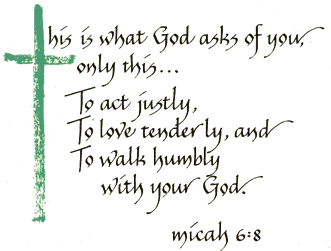
©1996 Cards by Anne
Used with permission